Mindset
Affirmations that don't feel fake
5 min read · Updated

KEY TAKEAWAYS
- Affirmations that feel far from the truth can make people with low self-esteem feel worse (Wood, Perunovic and Lee).
- Reminding yourself of your values is the better-studied version (Cohen and Sherman).
- Good affirmations are believable, about what you do, allow progress and fit on one line.
- Keep them where you look every day, and notice when they're true.
You stand in front of the mirror. You say "I am confident and unstoppable." Something inside you says: no, you're not.
That little voice is the reason most affirmations fail. And research suggests it's worth listening to.
The best affirmation is one you can say without rolling your eyes.
What is an affirmation?
A short, positive sentence you repeat to yourself. I can do hard things. Progress, not perfection. The idea: what you tell yourself often, you start to believe.
Sometimes that works. Sometimes it backfires.
Can affirmations make you feel worse?
Yes, for some people.
Psychologists Joanne Wood, Elaine Perunovic and John Lee asked people to repeat "I am a lovable person." People who already felt good about themselves felt a little better. But people with low self-esteem felt worse than people who didn't repeat it at all.
Why? When a sentence is far from how you feel, your mind argues back. Every repeat reminds you of the gap.

Everything in sight. On one board.
Tasks, notes, photos and plans as cards on one calm board. No charge today. Cancel anytime.
Start 7 days freeOr see all templates →What kind of affirmation actually helps?
There's a better-studied cousin called self-affirmation. Instead of telling yourself something big, you remind yourself of what matters to you: your values, the people you love, what you do well.
A review by Geoffrey Cohen and David Sherman looked at many studies of this. Thinking about your own values can help people stay calmer and more open when things get stressful.
So the most useful affirmations are less "I am amazing" and more "this is what I care about, and this is what I do."
How do I write affirmations that feel true?
Four rules:
- Believable. I'm getting stronger every week beats I am the strongest.
- About what you do. I keep promises to myself beats I am perfect.
- Allow progress. Small steps still count.
- Short. One line you can remember without looking.
What are some examples?
A few more that most people can say honestly:
- I can do one small thing today.
- I don't have to have it all figured out.
- Rest is part of the work.
- I've done hard things before.
Can an affirmation be a check-in?
Yes, and this kind is easy to believe, because you choose the words each day.
Some days your three words will be tired, busy, okay. That's fine. Honest beats nice.
What about words for the whole year?
Instead of a long list, pick three words for the year. Short enough to remember. Broad enough to fit any day.
Where should I keep my affirmations?
Somewhere you look without trying.
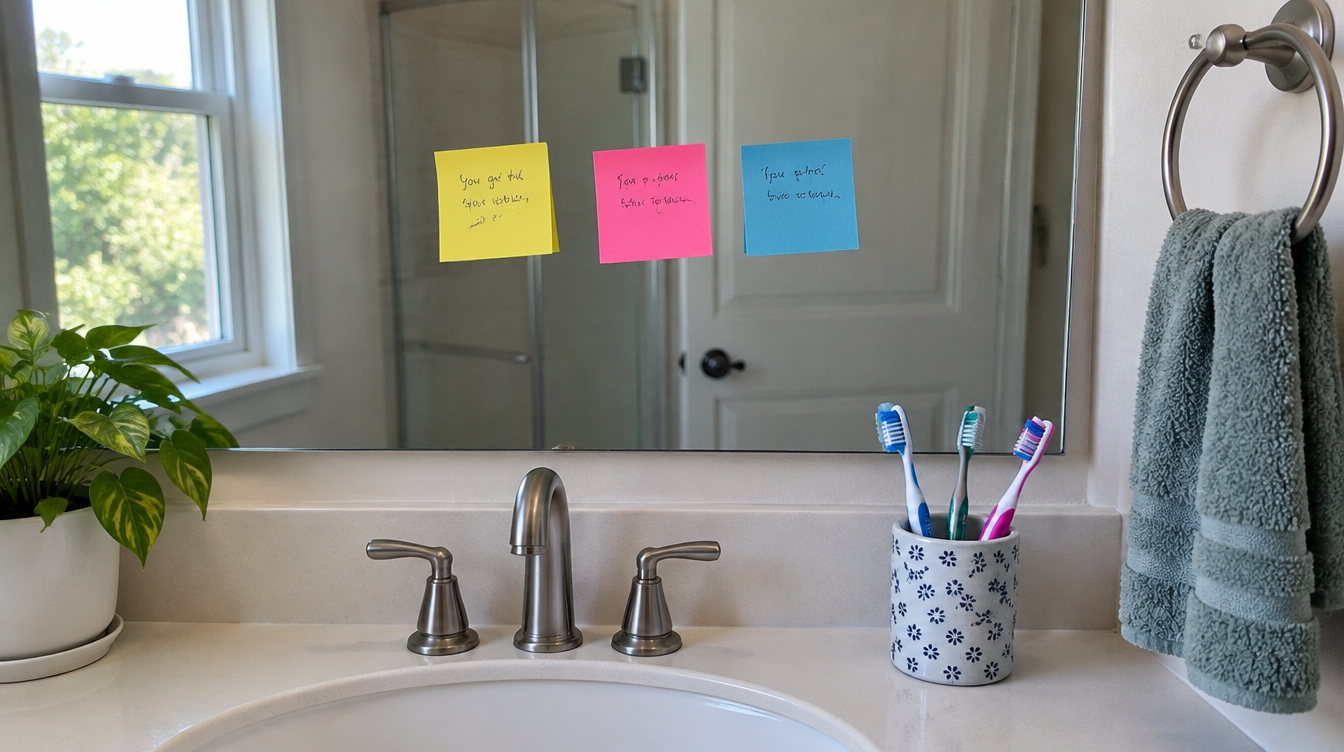
A list in a notes app gets buried under shopping lists. A few colourful post-its on your board are seen every time you open it. One colour per line makes each one easy to spot. More on why seeing beats remembering.
A 30-second morning routine
- Open your board with your coffee.
- Read the post-its once, slowly.
- Pick one for today.
- Notice when it's true during the day.
That last step is the one that counts. You're not trying to convince yourself. You're collecting proof.
What does a mindset board look like?
A few post-its with lines that feel true, a calm photo, a journal for the good things, and a short note to yourself.
Your affirmation check
Screenshot this. Run every line through it.
- Can I say it without rolling my eyes?
- Is it about what I do?
- Does it allow progress?
- Is it one short line?
- Will I see it tomorrow?
Write one affirmation tonight that you can say honestly tomorrow.
Questions
Do affirmations work?
It depends on the words. In a study by Wood, Perunovic and Lee, people with low self-esteem felt worse after repeating a sentence that felt untrue. Believable lines about what you do and value work better.
Why do affirmations feel fake?
When a sentence is far from how you feel today, your mind argues back. Every repeat reminds you of the gap.
How do I write an affirmation that feels true?
Make it believable, about what you do, open to progress and short. Adding 'I'm learning to…' often makes a big sentence honest.
What is self-affirmation?
Reminding yourself of your values and what matters to you. Research reviewed by Cohen and Sherman found it can help people stay calmer and more open under stress.
Where should I keep my affirmations?
Somewhere you look without trying, like a few post-its on a board on your phone, not a list buried in a notes app.
Sources
- Wood, J. V., Perunovic, W. Q. E., & Lee, J. W. (2009). Positive self-statements: Power for some, peril for others. Psychological Science, 20(7), 860–866.
- Cohen, G. L., & Sherman, D. K. (2014). The psychology of change: Self-affirmation and social psychological intervention. Annual Review of Psychology, 65, 333–371.
Try it on your own board.
No charge today. Cancel anytime.
Start 7 days free