Vision boards
Why your vision board isn't working (and the 5-minute fix)
5 min read · Updated

KEY TAKEAWAYS
- Vision boards stop working when they're out of sight, too full, or only show the finish.
- Only picturing the happy result can lower effort and energy (Oettingen; Kappes and Oettingen).
- Picturing the process led to more effort and better results than picturing the outcome (Pham and Taylor).
- Five dreams, one goal card with steps, on your phone, looked at for ten seconds a day.
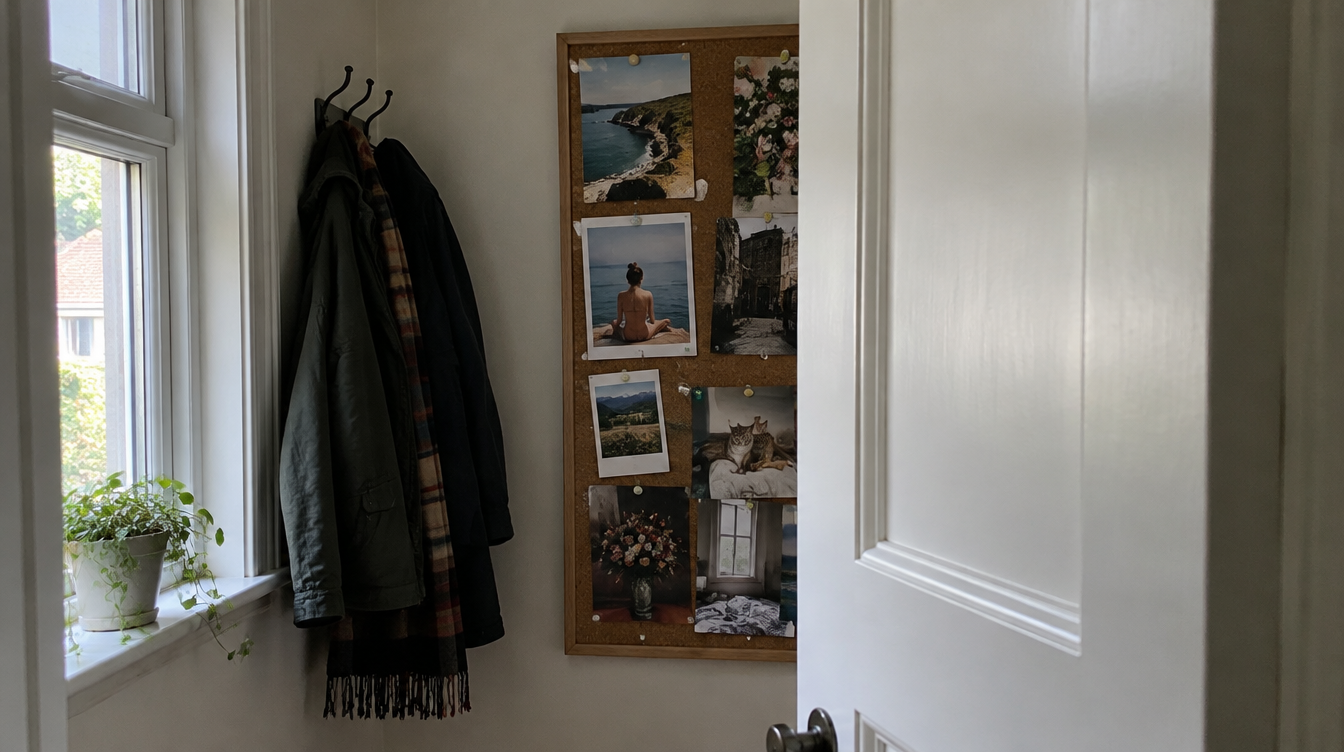
You spent a Sunday with scissors and magazines. The board looked great. You hung it in the hallway.
A month later, you walk past it every day without seeing it at all.
Your vision board didn't fail because the dreams were wrong. It failed for three simple reasons. Here they are, with a fix that takes five minutes.
Your vision board doesn't need more pictures. It needs more looks.
Reason 1: Why do I stop seeing my vision board?
Because your brain stops noticing things that never change.
It's the same reason you stop hearing the fridge hum. Something that's always in the same place, looking the same way, fades into the background. A board on a wall becomes wallpaper.
Fix: put it where you look on purpose, every day. For most people, that's their phone. And change something now and then. A new photo makes you look again.
Reason 2: Is there too much on it?
Twenty-five pictures means nothing stands out. Your eye skims across all of them and lands on none.
Fix: five dreams, not twenty-five. One photo per dream. One short line.
The line matters. Travel more is a wish. Through Italy by camper, slowly is something you can picture.

Everything in sight. On one board.
Tasks, notes, photos and plans as cards on one calm board. No charge today. Cancel anytime.
Start 7 days freeOr see all templates →Reason 3: Does it only show the finish?
This is the big one.
Psychologist Gabriele Oettingen has studied positive fantasies for years. In her research, people who only pictured the happy result often put in less effort. In one study with Heather Barry Kappes, positive fantasies even lowered people's energy. The dream felt so good that the body relaxed, as if the job was done.
A wall full of finish lines can do the same.
Fix: next to your favourite dream, add the road. A goal card with a date, the why, the milestones and the first step.
Should I picture the result or the process?
Picture both. Just don't skip the process.
In a classic study, psychologists Lien Pham and Shelley Taylor asked students to imagine an exam. Students who pictured studying (where they'd sit, what they'd read) studied more and scored better than students who pictured the top grade.
Dream big. Then picture the Tuesday evening that gets you there.
How do I fix my vision board in 5 minutes?
- Pick five dreams. A place, a feeling, a person, a project, something you'd love to do.
- Find one photo for each. Your own is best. A screenshot is fine for now.
- Write one line, as if it already happened: Our home by the sea.
- Turn your top dream into a goal card with a date and a first step.
- Put it on your phone, not on a wall.
How do I make sure I keep looking?
Add one small reminder to the board itself.
Then add a habit card and tick the mornings you looked. Ten seconds with your coffee.
How often should I change it?
Once a month. Scroll through and ask: Is this still what I want?
Swap what no longer fits. A board that changes is a board you keep looking at. For the full step-by-step, see how to make your vision board on your phone.
Does a vision board actually work?
Honestly: a picture on its own won't make anything happen. There's no good research that says it does.
What a vision board can do is keep your reason in sight. That makes the small, boring steps feel worth it. And research on goals is clear that seeing your goal and tracking your progress helps. More in why seeing beats remembering.
What does a working vision board look like?
A handful of dreams with a photo and a line, one goal card with real steps, a reminder post-it and a habit tracker. On one screen, on your phone.
Your 5-minute vision board check
Screenshot this.
- Do I see it every day?
- Five dreams or fewer?
- One photo and one line per dream?
- Is there a goal card with a first step?
- Did I change something this month?
Open your vision board tomorrow morning and look at it for ten seconds.
Questions
Why isn't my vision board working?
Usually because it is out of sight, has too many pictures, or only shows the finish without any steps toward it.
Do vision boards really work?
A picture alone won't make anything happen. A vision board helps when it keeps your reason in sight and sits next to real steps you take.
How many pictures should be on a vision board?
About five dreams, with one photo and one short line each, so every picture still stands out.
Should I visualise the result or the steps?
Both, but don't skip the steps. Students who pictured studying did better than students who only pictured a top grade (Pham and Taylor).
Where should I keep my vision board?
Somewhere you look every day on purpose, like your phone. A board on a wall soon fades into the background.
Sources
- Kappes, H. B., & Oettingen, G. (2011). Positive fantasies about idealized futures sap energy. Journal of Experimental Social Psychology, 47(4), 719–729.
- Pham, L. B., & Taylor, S. E. (1999). From thought to action: Effects of process- versus outcome-based mental simulations on performance. Personality and Social Psychology Bulletin, 25(2), 250–260.
- Harkin, B., Webb, T. L., Chang, B. P. I., et al. (2016). Does monitoring goal progress promote goal attainment? A meta-analysis of the experimental evidence. Psychological Bulletin, 142(2), 198–229.
Try it on your own board.
No charge today. Cancel anytime.
Start 7 days free